



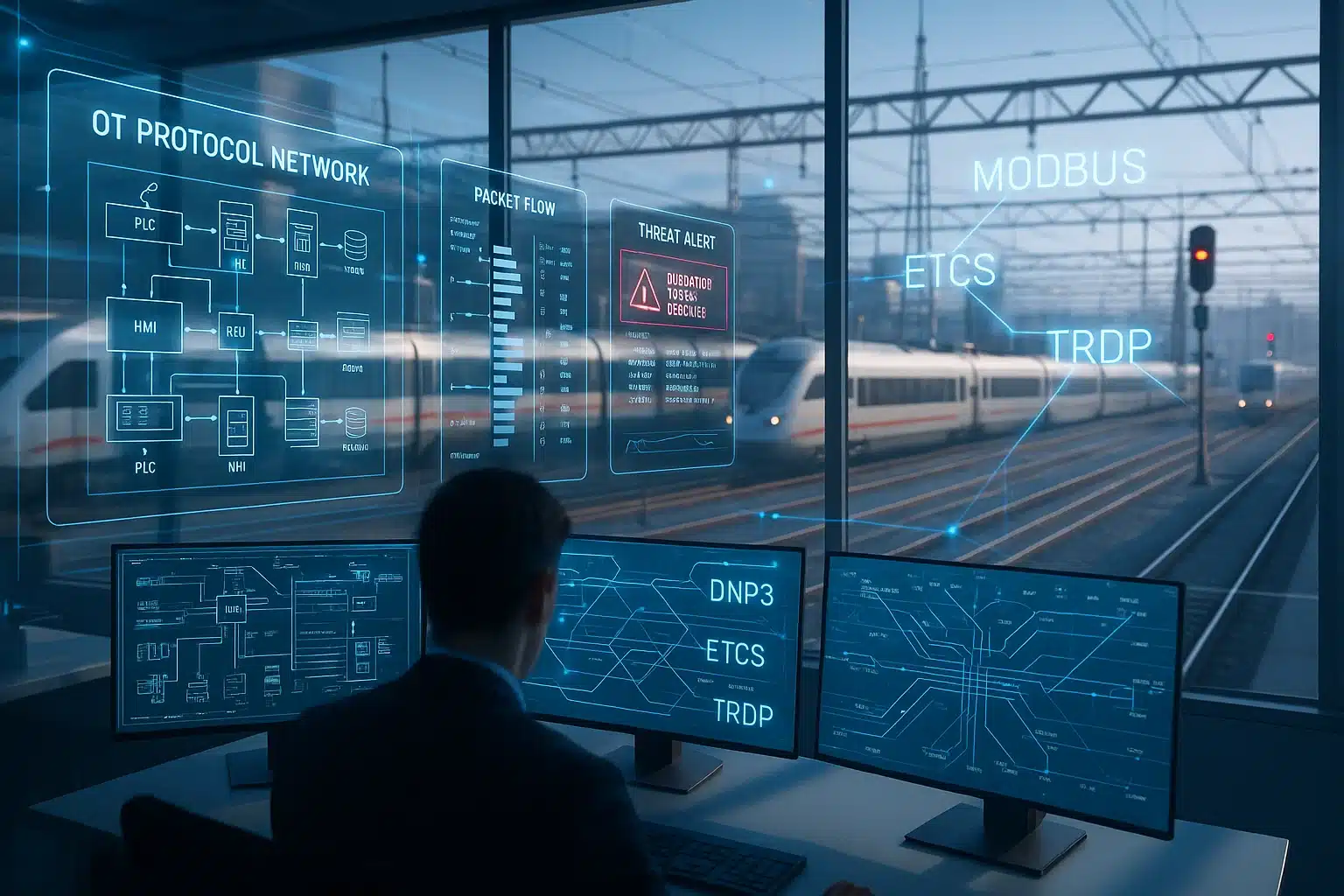
Understanding Rail OT Protocols: Common Vulnerabilities and Mitigation Techniques
The operational technology (OT) landscape in the rail industry relies heavily on specialized communication protocols. These protocols support essential systems such as signaling, interlocking, power control, and onboard equipment. Unlike common IT protocols, OT protocols used in rail were designed with safety and reliability in mind, not security.
As a result, many of these protocols expose significant vulnerabilities that threat actors can exploit. For cybersecurity managers, understanding these risks and applying targeted mitigation strategies is essential for protecting operational continuity and passenger safety.
Common OT Protocols in Rail Networks
Rail systems use a mix of industry-standard and proprietary protocols to facilitate control and monitoring. These include:
- Modbus: Widely used in SCADA systems and signaling infrastructure
- DNP3: Common in power distribution and remote control systems
- IEC 60870 and IEC 61850: Used for telecontrol in substations and energy systems
- Proprietary signaling protocols: Often developed by original equipment manufacturers for specific interlocking or train control functions
- CAN-based protocols: Found in rolling stock and onboard control units
- TRDP protocol: Used for real-time data transmission in train networks
- SAHARA (Safe, highly available, and redundant protocol): Designed for redundancy in rail safety systems
- ETCS (European Train Control System) with an information layer proprietary to vendors: This signaling standard often includes vendor-specific implementations that can create undocumented vulnerabilities
Each protocol brings different technical characteristics, but most were developed during a time when air-gapped systems were the norm. Today, with growing connectivity and remote access, these protocols face increasing exposure.
Vulnerabilities in Rail OT Protocols
The most common vulnerabilities across OT protocols include:
- Lack of encryption: Many protocols transmit data in clear text, making it easy for attackers to intercept or manipulate commands
- No authentication: Commands and responses can be spoofed by any actor with network access
- Broadcast behavior: Certain messages are sent to all nodes, increasing the potential for disruption
- Predictable structure: Attackers can reverse-engineer protocol formats and craft malicious payloads
- Vendor-specific weaknesses: Proprietary extensions often introduce undocumented vulnerabilities that are not covered by standard tools
These vulnerabilities create multiple entry points for malicious actors. A compromised control packet sent to the wrong device could disrupt signaling, power supply, or communication with rolling stock.
Mitigation Strategies and Best Practices
Cybersecurity managers cannot simply replace OT protocols across a live rail network. Instead, they must deploy layered strategies that reduce exposure and detect malicious behavior early. Key practices include:
- Protocol-aware monitoring: Use cybersecurity solutions that understand OT protocols and detect abnormal message structures or unauthorized commands
- Network segmentation: Separate control zones using firewalls and access control lists to limit the spread of potential attacks
- Whitelisting and command validation: Define accepted behaviors and block or alert on deviations from established patterns
- Secure remote access: Apply multi-factor authentication and session monitoring for vendors or maintenance teams accessing control systems
- Time synchronization checks: Verify that messages fall within expected timing parameters to detect replay attacks or spoofing attempts
These techniques create protective boundaries without needing to alter the legacy protocols themselves.
The Importance of Visibility
Without deep visibility into protocol-level communication, threat detection becomes reactive and unreliable. Tools designed for IT environments often miss critical events in OT networks because they lack awareness of rail-specific behavior.
Cervello’s monitoring platform delivers visibility into rail OT traffic by decoding protocol structures, analyzing message sequences, and flagging anomalies. This capability allows cybersecurity managers to respond to threats before they impact operations.
Aligning with Standards and Regulations
Rail organizations must align their protocol protection efforts with established standards such as IEC 62443, which calls for secure communications, device integrity, and risk-based zoning. Regulatory requirements from the TSA in the United States and the NIS2 directive in Europe also stress the importance of monitoring, incident detection, and network security.
By proactively managing protocol vulnerabilities, cybersecurity teams can not only improve operational defense but also demonstrate regulatory readiness.
Conclusion: Protecting the Language of Rail Systems
Author
Jump to