



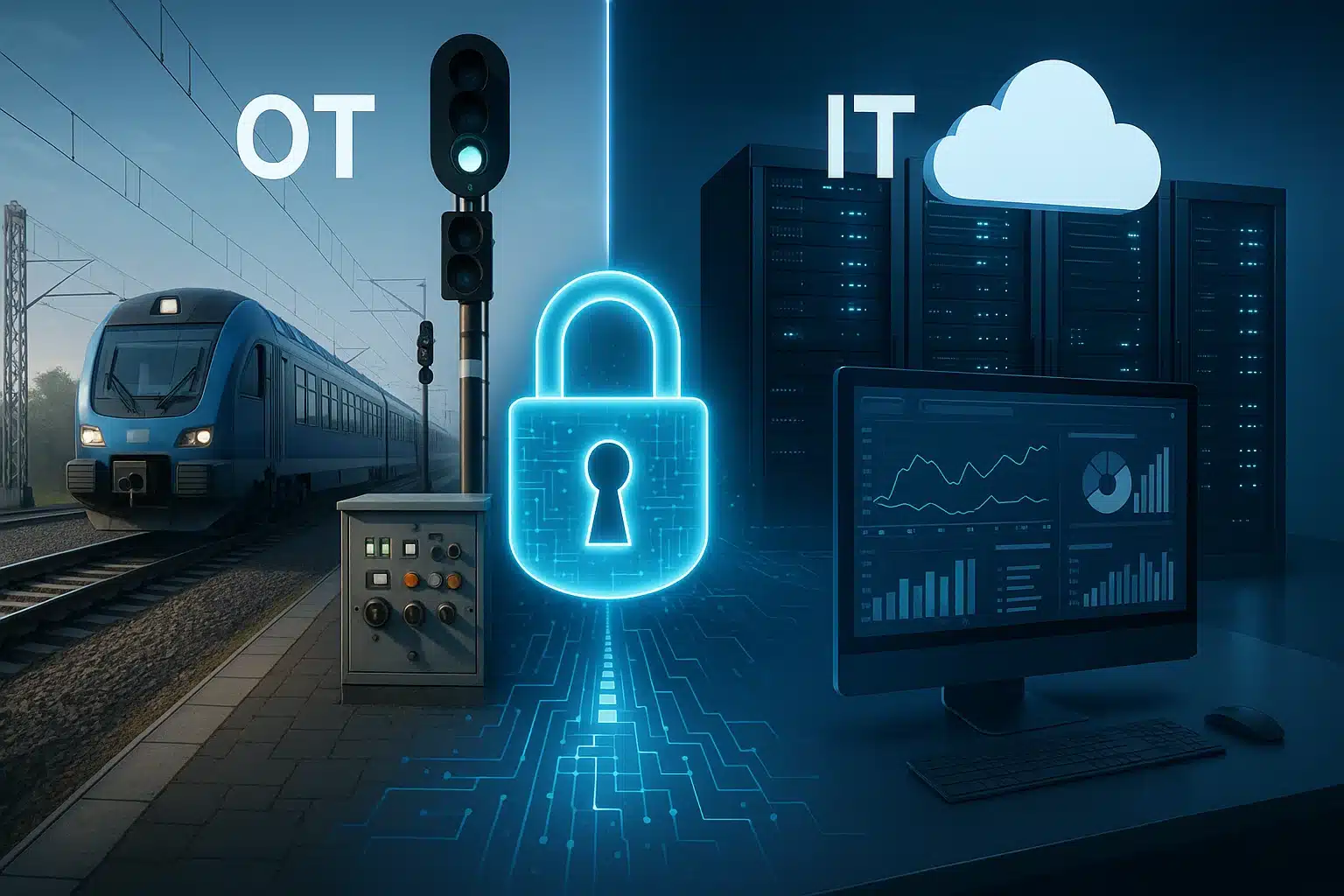
From OT to IT: Bridging the Gap for Effective Cybersecurity in Rail Networks
The boundaries between operational technology (OT) and information technology (IT) are becoming increasingly blurred. Rail operators once relied on isolated OT systems to manage critical functions such as signaling, control, and interlocking. Today, these systems are being integrated with enterprise IT platforms for real-time data exchange, predictive maintenance, and centralized control.
This convergence creates new opportunities for efficiency and innovation, but it also introduces complex cybersecurity challenges. Cybersecurity managers must ensure that IT-OT integration enhances safety and reliability, rather than increasing exposure to threats.
Understanding the Difference Between OT and IT in Rail
OT systems in rail are responsible for physical processes. They include components like programmable logic controllers, remote terminal units, and human-machine interfaces (HMIs) that manage train movements, switches, and power distribution. These systems are highly sensitive to latency, disruption, and unexpected change.
IT systems, on the other hand, are designed for data processing, enterprise management, and user interaction. They typically involve laptops, servers, databases, and private cloud services.
Integrating the two environments requires a deep understanding of both their technical foundations and their operational priorities.
Challenges Introduced by Convergence
The merging of OT and IT environments introduces several key risks:
- Expanded attack surface: More points of connectivity increase the opportunities for cyber intrusion
- Protocol incompatibility: IT tools may not fully understand OT protocols, leading to monitoring gaps
- Asset visibility limitations: IT teams often lack insight into OT networks, and vice versa
- Unmanaged third-party access: Vendors and maintenance teams may use remote connections that bypass internal controls
- Conflicting priorities: IT departments may prioritize convenience and speed, while OT teams prioritize safety and reliability
To manage these challenges, cybersecurity teams must adopt a unified approach that balances the needs of both environments.
Strategies for Bridging the Gap
A successful OT-IT convergence strategy begins with collaboration. Cybersecurity managers must act as facilitators between departments, vendors, and technical teams. Key practices include:
- Unified asset inventory: Create a central view of all devices, applications, and communication paths across both environments
- Network segmentation: Use firewalls and policy enforcement to separate IT and OT zones while enabling secure data exchange
- Contextual monitoring: Deploy tools that understand both IT events and OT behaviors to detect cross-domain threats
- Role-based access control: Ensure that user privileges are defined based on operational need and reviewed regularly
- Joint incident response planning: Coordinate response procedures that account for dependencies across IT and OT systems
These measures help create a secure, transparent, and efficient environment where both domains can operate safely.
Real-World Benefits of a Unified Approach
When OT and IT teams collaborate effectively, the entire organization benefits:
- Faster response to threats that span both domains
- More accurate root-cause analysis during incident investigations
- Enhanced compliance with frameworks such as IEC 62443 and NIST CSF 2.0
- Improved reliability of systems that depend on synchronized operations
- Streamlined vendor and contractor management
In practice, this also reduces duplicated tools, conflicting alerts, and security blind spots.
How Cervello Supports OT-IT Integration
Cervello’s platform is designed with OT-IT convergence in mind. It offers deep visibility into rail-specific OT protocols while also integrating with IT security tools and dashboards. This enables cross-functional teams to work from a single source of truth. By bridging the gap between domains, Cervello helps rail operators maintain full situational awareness, streamline workflows, and improve security posture.
Conclusion: Building a Unified Security Strategy
OT and IT no longer exist in isolation. Their convergence is shaping the future of railway operations. For cybersecurity managers, the responsibility is clear: protect both environments as part of a single, cohesive strategy. With the right architecture, visibility, and cross-functional coordination, operators can unlock the full potential of digital transformation without compromising safety or security.
Author
Jump to